
Do Life Coaches Need Certification in Australia? The Essential Guide
The Legal Reality of Coaching in Australia
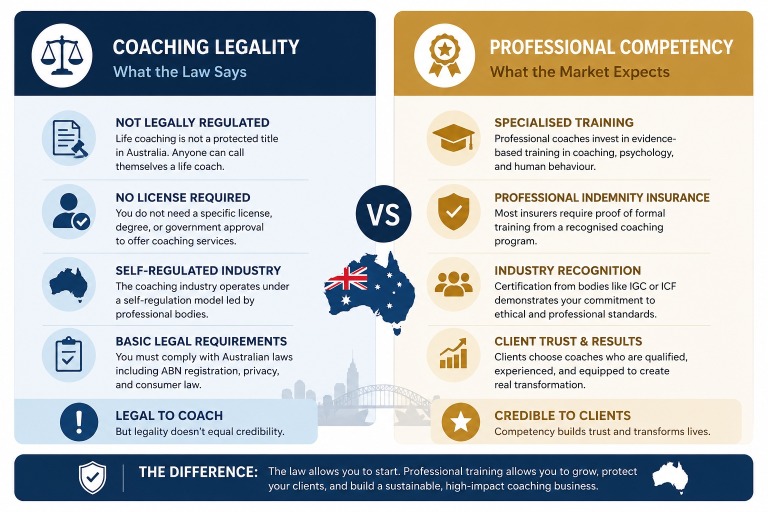
Unlike psychology, counseling, or medical professions, the term "Life Coach" is not a protected title under Australian law. This means that, technically, anyone can offer coaching services.
However, the industry is governed by a Self-Regulation Model. Professional bodies—such as the International Guild of Coaches (IGC) and the International Coach Federation (ICF)—set the ethical and competency standards that separate hobbyists from professional transformational coaches.
Certification vs. Qualification: What’s the Difference?
It is important to distinguish between simply "having a certificate" and being truly "qualified" to facilitate human change.
- Legality: You can legally coach without any training.
- Competency: Professional training provides the psychological frameworks (such as Meta Dynamics™) required to handle complex client breakthroughs safely and effectively.
- Credibility: In a competitive market, a certification from a recognized institution like The Coaching Institute acts as a "seal of trust" for prospective clients.
Why Professional Certification is the Market Standard
While the law doesn't require it, the market does. If you intend to build a sustainable, six-figure coaching business, certification provides three critical advantages:
1. Professional Indemnity Insurance: Most Australian insurers will not provide professional indemnity or public liability insurance to coaches who cannot demonstrate they have completed a verified training program.
2. Corporate Opportunities: If you wish to consult for Australian businesses or government sectors, a recognized qualification is almost always a prerequisite for their procurement process.
3. Client Trust: Today’s coaching clients are more informed than ever. They are looking for coaches who have invested in their own growth and adhere to a professional code of ethics.
The Role of Professional Bodies
In the absence of government regulation, organizations like the International Guild of Coaches (IGC) serve as the "quality control" for the industry. Aligning with a school that meets these global standards ensures that your training is not just a piece of paper, but a reflection of a high-level competency framework.

The Path to Becoming a Certified Coach
If your goal is to transition from a corporate career or start a dedicated coaching practice, the most successful path in Australia involves:
- Choosing a program that focuses on Transformational Coaching (identity change) rather than just "Advice Giving."
- Ensuring the training includes mentored practice hours.
- Selecting a school with a strong Australian community and business-building support.

Frequently Asked Questions
- Can I call myself a life coach without a degree?
Yes. You do not need a university degree to be a life coach in Australia. Most professional coaches opt for specialized vocational training that focuses on behavioral science and coaching methodologies. - Is life coaching regulated in Australia?
No, it is a self-regulated industry. Professional standards are upheld by private industry bodies rather than the government. - Do I need a certificate to get coaching insurance?
Generally, yes. To be covered for professional indemnity in Australia, most insurers require proof that you have completed a recognized coaching course. - How long does it take to get certified?
This varies by the level of expertise you seek. Foundations can be laid in a few months, while professional-level mastery (such as a Diploma or Master Practitioner) typically takes 6 to 18 months of study and practice.
